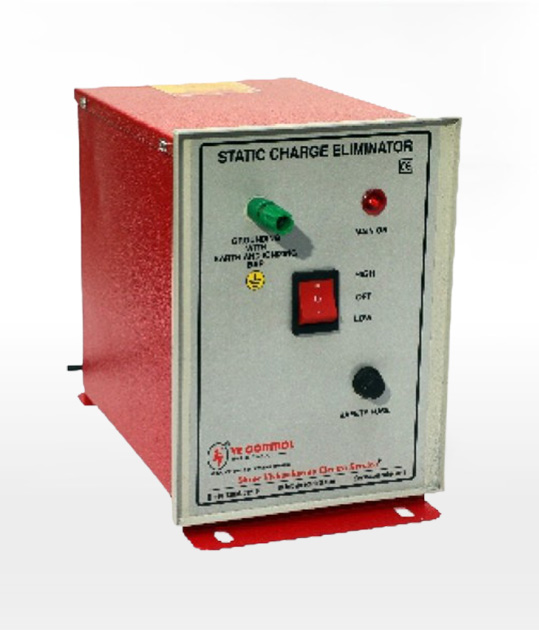
Static is a stationary electric charge, which forms on the surface of non- conductors
(insulators) and un-grounded or isolated conductors. Friction, pressure and
separation are the main reasons for the creation of static. If two materials come in
contact with each other and are then separated, electrons may be transferred from
one to the other. A change in temperature also creates charge. Static electricity is thus
an imbalance of positive and negative charges. When a moving web comes in contact
with a rubber, steel, or an aluminium roller and then separates from it, static electricity
gets created on both the web and the roller. As bare lms, paper and rubber rollers
are non-conductive, there is no free ow of electrons. Thus the static charge on lms
and paper dissipates very slowly. Metal rollers and foils being conductive allow free
ow of electrons to ground, since they are invariably earthed. However, conductors
will develop a static charge if they are insulated from the ground. The magnitude of
the static charge will depend on the material, applied forces, separation rate,
temperature and relative humidity